So, What Size?
One of the questions I get most often about my sock patterns is some version of this:
“I wear EU 39. How many stitches should I cast on?”
Or 37. Or 40. Or 43.
And I completely understand why this feels like the most logical question in the world. You open a sock pattern, see several stitch counts, and naturally want to match one of them to your shoe size. But the truth is, your shoe size doesn’t really tell me how many stitches you need.
Length Is the Easy Part
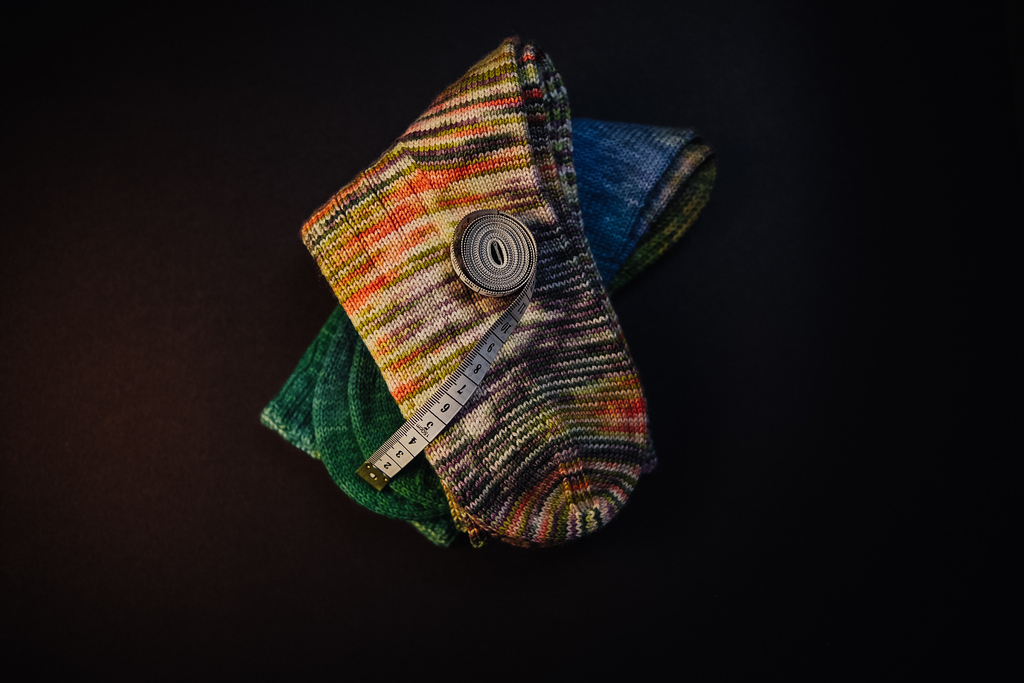
A shoe size mostly tells us about foot length. And length is actually the easy part when knitting socks. You simply keep knitting until the foot is long enough, then start the toe at the right point. I usually start the toe about 5 mm before reaching the tip of my little toe.
The number of stitches around the sock is a different story. That number is mostly about circumference.
Two people can both wear EU 39 and have completely different feet. One can have a narrow foot, the other a wide one. One can have a high instep, the other a very low one. Same shoe size, very different sock.
And then there is gauge. And the little swatch that tells you what your gauge actually is. Which, in my opinion, is where all the fun begins.
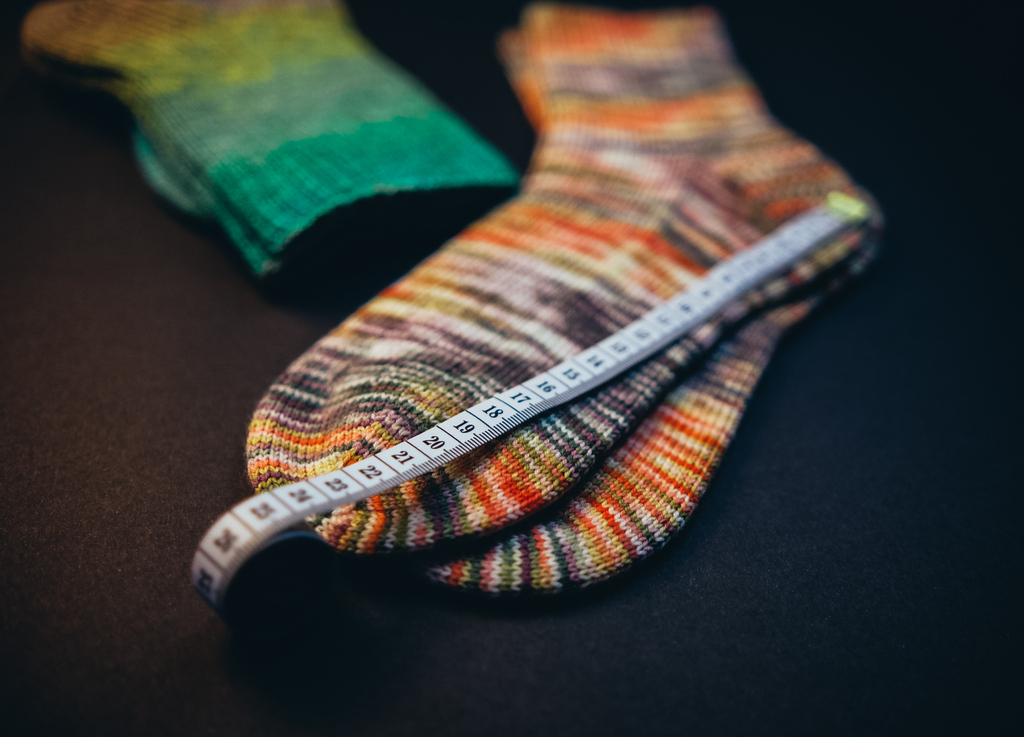
I have knitted from a lot of sock patterns over the years, and I still remember how confusing this felt in the beginning. I would look at a pattern, see several stitch counts and think: okay… but where is the actual size?
It took me a while to understand that the stitch count was never meant to be a shoe size in disguise. It only really makes sense together with gauge and the finished circumference of the sock. And gauge is always about your hands, this yarn and these needles. Someone else can use exactly the same yarn and exactly the same needle size and get a completely different fabric.
Some of us knit loosely. Some of us knit tightly. Some of us apparently knit so tightly that 80 stitches for a fingering-weight sock feels perfectly normal.
Hi. That would be me.
I Stopped Chasing Gauge
I almost never match pattern gauge. Actually, I’m trying to remember if I have ever matched the gauge in someone else’s sock pattern exactly, and I honestly can’t think of a single time.
For years I kept seeing the same advice:
“If your gauge is too tight, go up a needle size.”
Perfectly sensible advice. Except it never really worked for me. Yes, technically I could get fewer stitches per 10 cm with larger needles. But I didn’t like the fabric anymore. It became looser, softer, floppier than I wanted my socks to be.
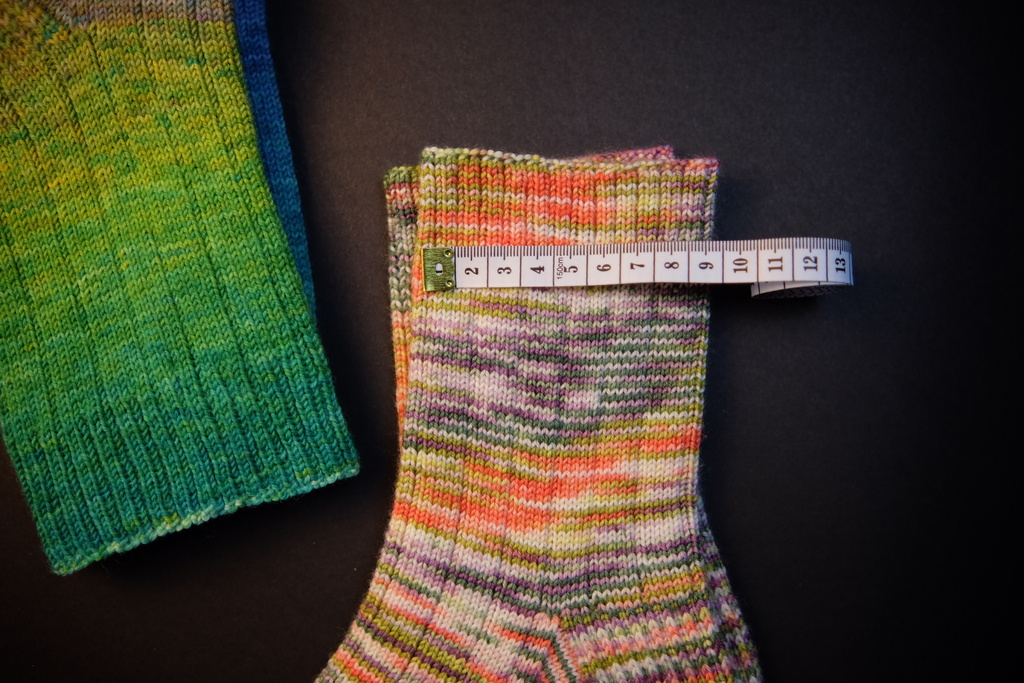
I was getting closer to someone else’s gauge and further away from the kind of sock fabric I actually liked. At some point I stopped trying to make my hands knit like someone else’s hands. And that made sock knitting much easier.
These days, most of my adult socks are knitted with 80 stitches. Yes. Eighty. I know that sounds like a lot if you are used to seeing 60, 64 or 68 stitches in sock patterns. But I knit very tightly, and 80 stitches gives me the kind of fabric and fit I like. The funny thing is that I can knit an EU 39 sock on 80 stitches, and I can also knit an EU 45 sock on 80 stitches. The larger one is simply longer.
Of course, foot shape still matters. A very wide foot, a high instep or a very different ankle circumference may need adjustments. But this is exactly why the stitch counts in a pattern only make sense together with gauge and the actual measurements of the sock. Useful guidance. Very useful guidance. But still guidance.
Finding a Starting Point
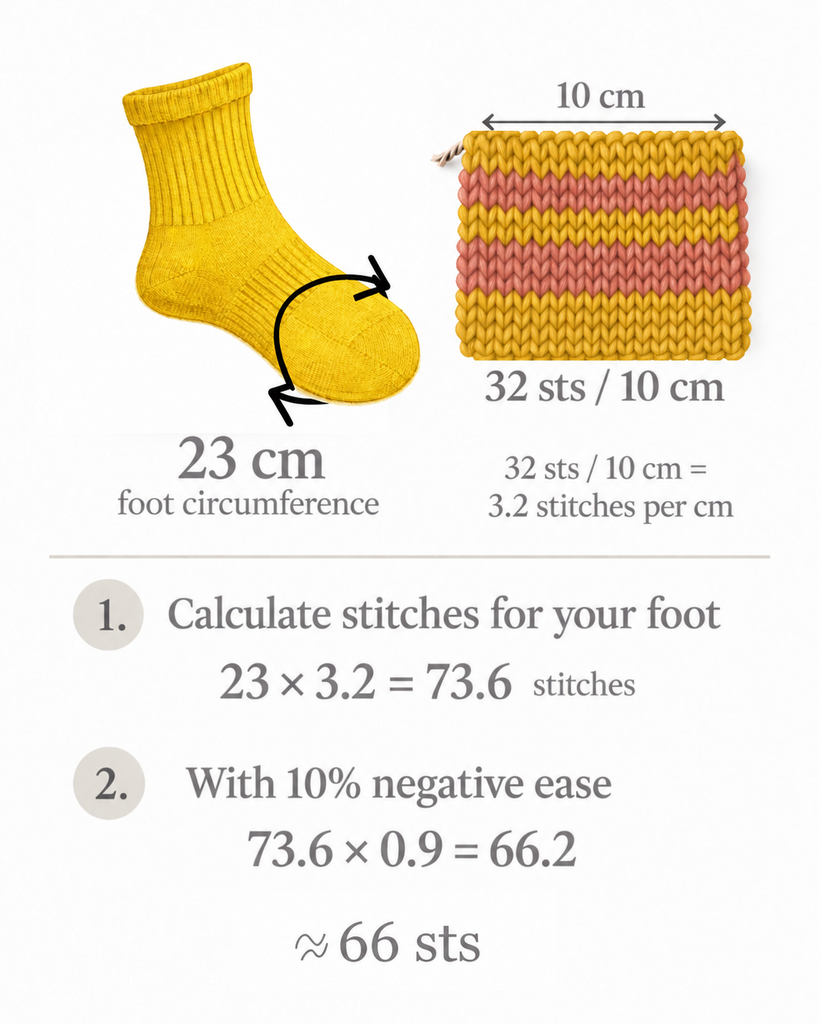
If you want to make a more informed choice, start with your foot circumference. Measure around the widest part of the foot. Then look at your stitch gauge.
Let’s say your foot circumference is 23 cm and your gauge is 32 stitches per 10 cm.
That means:
32 ÷ 10 = 3.2 stitches per cm
23 × 3.2 = 73.6 stitches
But socks usually need some negative ease. We want them slightly smaller than the foot so they stretch and stay in place.
If we use around 10% negative ease:
73.6 × 0.9 = 66.2
So around 66 stitches would be a very reasonable place to start. And I would still call it exactly that: a very educated first guess. Because numbers can get you close. Then the actual sock tells you the rest.
Let the Sock Tell You
And this is where I have a slightly different relationship with swatching.
If a brave beginner asked me what I would personally do, I might say this:
Choose the size (stitch count) that comes reasonably close to the number you got from your gauge calculation. Cast on. And knit the sock. The whole sock. Let that sock be your real swatch.
A small square can tell you your gauge. A sock can tell you much more. You find out very quickly whether you actually like the fabric and how the whole thing behaves on a real foot. Does the cuff stretch enough? Does the leg feel too tight? Does it slide over the heel comfortably? Is there enough room over the instep? Does the foot feel snug or loose? And, of course, do you actually like the toe? Maybe most importantly, it gives you a reference point for the next pair.
Perhaps your first sock is a little too tight. Fine. Now you know. Perhaps it is too loose. Also fine. Now you know that too. That one sock has already taught you more about your own knitting than a size chart ever could.
And no, I am not saying everyone should stop swatching.
If you love swatching, please swatch. If you are knitting an expensive yarn and absolutely do not want to experiment with the whole sock, swatch. If you are making something very fitted or working with an unfamiliar construction, swatch.
But I also think beginners sometimes get so worried about getting every number exactly right before they begin that they never get to the part where their hands actually learn something.
You Learn What Works for You
Sock knitting becomes much easier after a few pairs.
Not because the formulas change. Just because you begin to know yourself.
You start to recognise your own gauge. You know that with this kind of fingering-weight yarn and your usual needles, you normally need something around 72 stitches. Or 76. Or 80. You know how much negative ease you like. You know whether your heel usually needs more room. You can look at a sock after a few centimetres and already feel whether it is going to work.
That knowledge is incredibly useful. And it only comes from knitting.
So when you open a sock pattern and see several stitch counts, don’t look for your shoe size first. Look at the gauge. Look at the finished circumference if it is given. Measure your foot. Do the maths if you want to. Then choose the size that makes the most sense for your knitting.
And remember that the first answer does not have to be perfect. It just has to be good enough to begin.
Because the first sock will teach you more than you think.


You May Also Like

Valinor Socks
14.10.2025
It’s Just a Hat. Right?
04.11.2026