Scrappy Baglet: Stitch Orientation
Since releasing the Scrappy Baglet pattern, I’ve had a few questions about stitch orientation — especially around slipping stitches in R1 and R2 of the casing.
It made me realise that this is one of those little things we often do automatically and don’t really think about, even though different knitters can have their stitches sitting on the needle in completely different ways.
So I thought I’d put together a little explanation and show you what I mean in the video. Hopefully it helps make that part of the pattern a bit less confusing.

How stitches sit on the needle
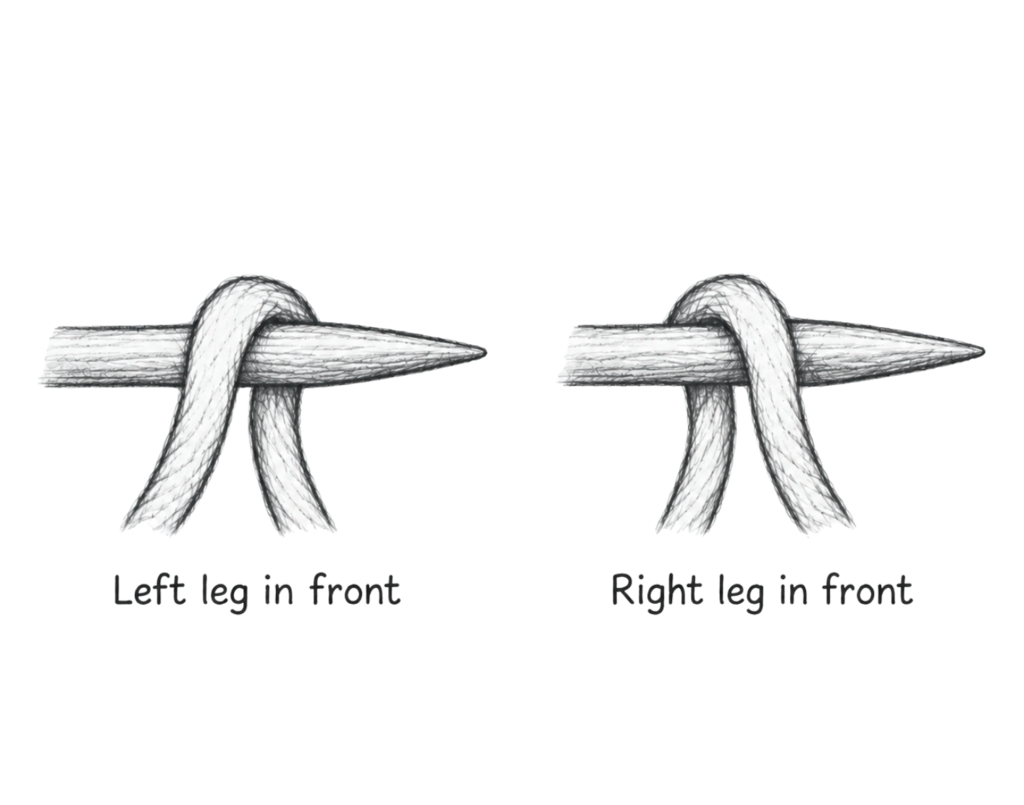
Every stitch has two legs: one sits in front of the needle and the other sits behind it.
But here is the part that can sometimes cause confusion: the right leg is not always the one in front.
Depending on how a stitch is formed, it can sit on the needle in two different orientations:
• the right leg can sit in front and the left leg behind
• or the left leg can sit in front and the right leg behind
Neither one is automatically wrong. They are simply different stitch mounts.
Why does this happen?
The way you form a stitch determines how the new loop lands on the needle.
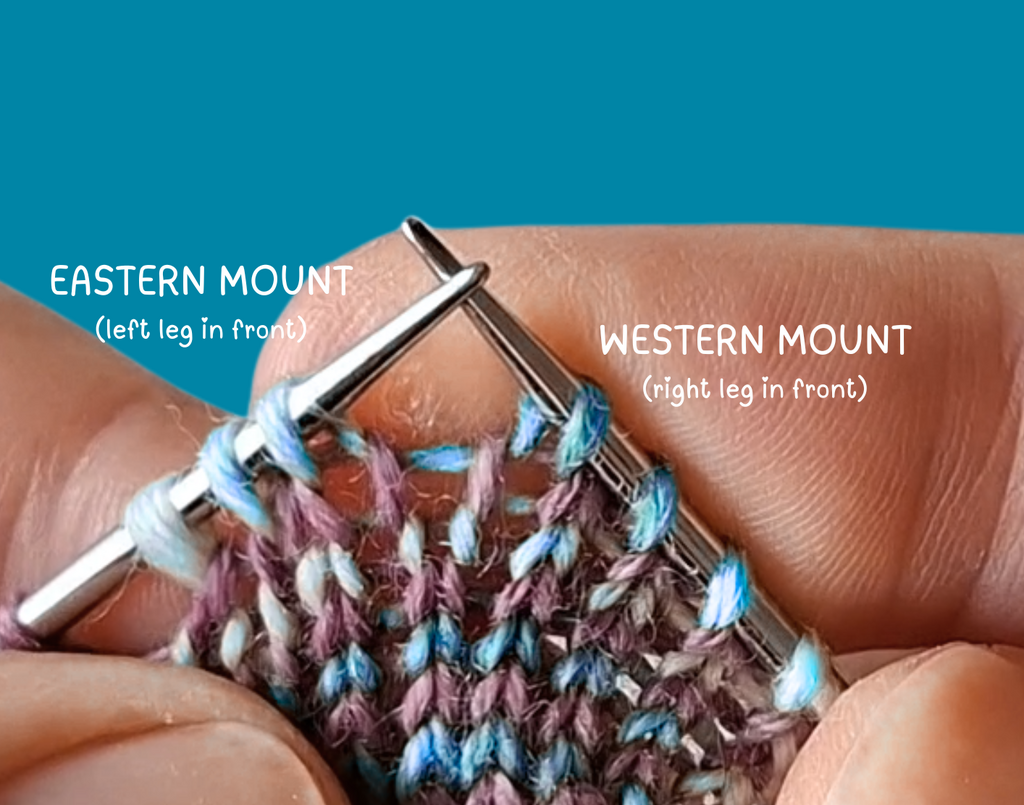
With a Western mount, the stitch normally sits with the right leg in front.
With an Eastern mount, the stitch sits the other way around, with the left leg in front.
This can happen with both knit and purl stitches, and some knitters use the same mount for both while others naturally use a combination of the two.
That is why two knitters can follow the same instructions, make what they both consider a perfectly normal knit or purl stitch, and still end up with their stitches sitting differently on the needle.
Western / Eastern vs English / Continental
Western and Eastern are not the same as English and Continental
This is an important distinction.
English and Continental knitting describe how you hold and manage the working yarn.
Western and Eastern mount describe how the stitch itself sits on the needle.
So a Continental knitter and an English knitter can both produce Western-mounted stitches. And a knitter can also use a combination of Western– and Eastern-mounted stitches depending on how they form their knits and purls.
The position of the yarn in your hand and the orientation of the stitch are two different things.
The leading leg
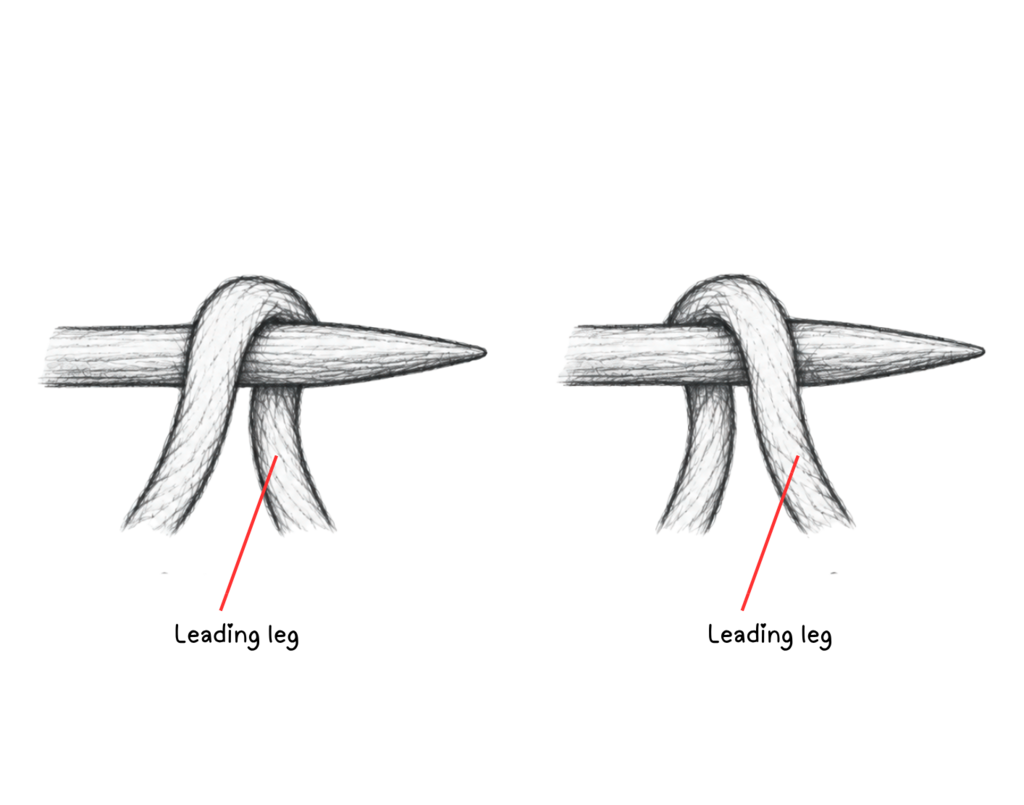
There is another useful way to look at a stitch: instead of thinking only about the front and back legs, look at which leg is closer to the tip of the needle.
That leg is often called the leading leg.
For a Western-mounted stitch, the leading leg is usually in front.
For an Eastern-mounted stitch, the leading leg is usually behind the needle.
In this video, I’ll show you how knit stitches can be formed with Western and Eastern mounts, so you can see how the different methods affect the way the stitches sit on the needle.
Why this came up in the Scrappy Baglet
This is exactly what happened with one small instruction in the Scrappy Baglet pattern.
In the second round of the double-knit casing I wrote:
sl1 wyif, remounting the slipped stitch with the right leg in front
In my own knitting, the stitches arrive at this point with the orientation you see in my video. Because of the way I form my stitches, I need to remount that slipped stitch so that its right leg ends up in front.
And that is exactly what I show in the tutorial.
But some knitters naturally arrive at this point with the stitch already sitting with its right leg in front.
For them, copying my exact hand movement would be unnecessary. In fact, remounting a stitch that is already in the correct orientation can make it tighter or even change its orientation again.
So the important part of that instruction is not:
“Move the stitch exactly the way I move it.”
The important part is:
“Make sure the slipped stitch ends up with the right leg in front.”
If it is already sitting that way, simply slip it with the yarn in front and leave its orientation unchanged.
If the right leg is at the back, remount the stitch as you slip it so that the right leg comes to the front.
In this video, I’ll show you how to slip the stitch so that it ends up with the right leg in front. If your stitch is already sitting with the right leg in front, you don’t need to make this adjustment.
The same result does not always require the same movement
This is probably the most useful thing to remember.
Knitting instructions often describe a movement, but knitters do not all start from exactly the same stitch orientation.
So sometimes the better question is:
What should the stitch look like after I have worked it?
rather than:
Did my hands make exactly the same movement as the designer’s?
If your stitches sit differently from mine, that does not mean you are knitting incorrectly.
It simply means that occasionally you may need to adapt the movement so that you reach the same final result.
And if a stitch suddenly becomes extremely tight, awkward to enter or seems to be fighting you, it is always worth stopping for a moment and looking at how that stitch is actually sitting on the needle.


You May Also Like

Hi, I’m Natalia
13.09.2026
Summer’s Here – At Last
15.06.2025